







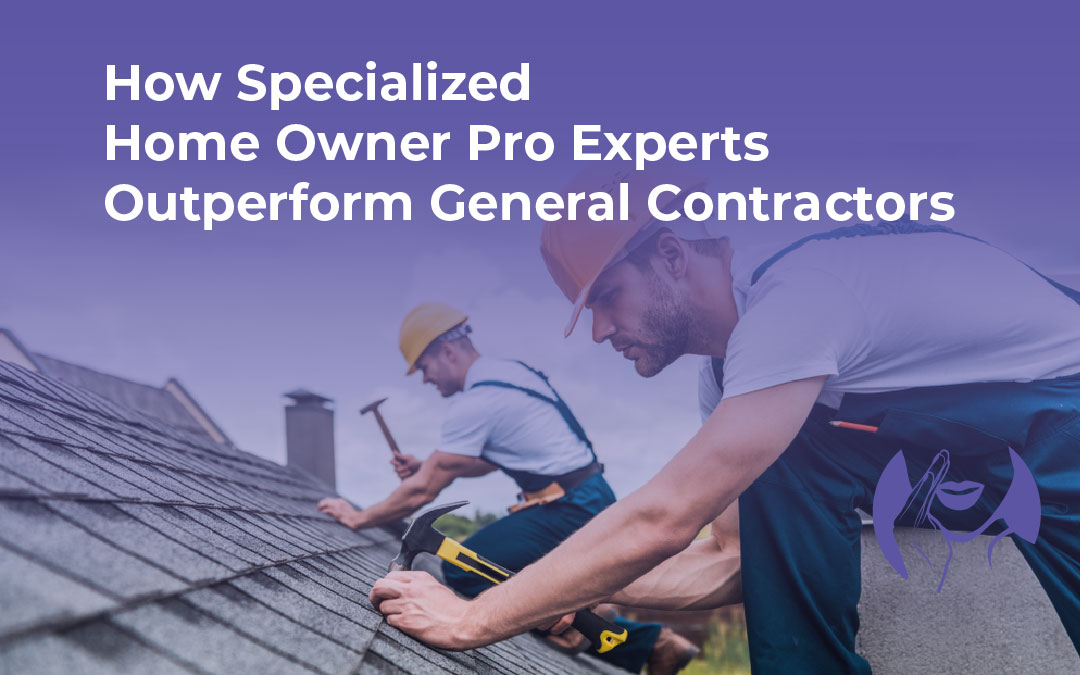
The home improvement industry is crowded. Every city has dozens of contractors claiming to do it all—roofing, plumbing, siding, windows, you name it. But here’s the truth: the fastest-growing, most profitable companies aren’t generalists. They’re specialists. They’ve mastered specific services and built their businesses around expertise, not a widespread of services.
This focused approach gives them advantages that generalists simply can’t match: sharper technical skills, more efficient operations, stronger supplier relationships, clearer marketing, and happier customers. Understanding why and how this works provides valuable insights for anyone building or scaling a home services business.
The Generalist’s Dilemma
General contractors often fall into the trap of trying to be everything for everyone. At first glance, it seems smart: more services, more potential clients, more revenue streams.
But in reality, this strategy creates serious headaches:
Diluted Expertise: Your team handles a bit of everything but masters nothing. They’re good at many things, excellent at none.
Operational Complexity: Every service comes with unique tools, processes, and suppliers. Managing it all drains time, energy, and resources.
Marketing Confusion: When your messaging tries to cover ten services, it ends up vague. Customers aren’t sure why they should choose you over another contractor.
Quality Inconsistency: Some jobs shine, others stumble. Inconsistent results hurt your reputation.
Resource Strain: Training, tools, and materials get stretched thin, leaving nothing truly optimized.
The contractors who succeed usually escape this trap by narrowing their focus and specializing in a few select categories.
The Power of Specialized Focus
Companies that focus on specific categories—roofing, windows, doors, siding, or exterior work—enjoy multiple strategic advantages:
Technical Excellence: Doing the same type of work repeatedly builds real expertise. Roofers who focus on roofs don’t just get the job done—they do it flawlessly, faster, and with confidence, delivering higher-quality results in less time.
Operational Efficiency: Repetition brings rhythm. Estimates are more accurate, material orders are optimized, and project management runs like clockwork.
Supplier Relationships: Buying consistently in one category gets attention. You get better pricing, priority service, and inside knowledge about new products and techniques. These relationships create cost advantages that directly improve margins.
Marketing Clarity: Instead of generic “we do everything” messaging, position yourself as the premier window installation company or the roofing specialists. This clarity makes your marketing far more effective and helps customers understand exactly why they should choose you.
Reputation Building: When you specialize, customers notice—and not only do referrals increase, but you can also confidently charge premium prices.
How Specialization Drives Profits
Specialization doesn’t just improve operations—it boosts the bottom line:
Higher Margins: Specialized expertise commands premium pricing. Customers will pay more for recognized experts than general contractors. Your costs decrease through operational efficiency while your prices can increase through market positioning.
Faster Project Completion: Specialized teams work faster because they’ve done similar projects hundreds of times. Faster completion means more projects per period, increasing revenue without proportionally increasing costs.
Lower Error Rates: Mistakes cost money—in materials, time, reputation, and sometimes litigation. Specialized teams make fewer mistakes because they’re working within their area of expertise.
Better Resource Utilization: Instead of maintaining diverse equipment and inventory for multiple service categories, you optimize for your specialties. This reduces capital requirements and storage costs while ensuring you always have what you need for your core services.
Predictable Costs: When you’re buying similar materials repeatedly, you can negotiate better terms, predict costs more accurately, and manage cash flow more effectively.
These advantages compound over time, creating growing gaps between specialist and generalist profitability.
Building the Specialist Business Model
Moving from being a generalist to a specialist—or starting a specialized business from scratch—takes some thoughtful strategy. It’s not just about picking a service; it’s about choosing the right ones that give your business room to grow.
Market Demand Analysis: Look at what people actually need. Roofing and window replacement, for example, are almost always in demand. Some services pop up occasionally, but others are steady cash flow. Focus on the ones that keep your schedule full.
Margin Potential: Not all services are created equal. Some are commoditized with razor-thin margins, while others let you charge premium prices. Picking services where you can make good money without overcomplicating costs is key.
Competitive Landscape: Check out the competition. Where are they falling short? The most profitable opportunities often come from areas where others are weak. Quality-focused specialists can stand out here.
Operational Synergy: Think about how your services fit together. If you handle roofing, siding, windows, and doors, there’s a natural overlap in skills and materials. Bundling related services can save time, reduce costs, and make your operations smoother.
Scalability: Can you find, train, and keep skilled professionals in this area? Some specialties are tough to staff, and that limits growth. Make sure the services you pick are sustainable from a staffing perspective.
The companies that really thrive don’t try to do everything. They pick 2-4 related services and go deep. That focus allows them to build expertise, deliver consistent quality, and grow without spreading themselves too thin.
Marketing Specialized Services
One of the biggest advantages of being a specialist is how much easier it makes marketing. Instead of spreading your message thin, you can target campaigns that speak directly to customers looking for the services you do best.
SEO Advantages: Search engines favor websites that are focused and authoritative. A site entirely devoted to roofing, for example, ranks far better for roofing searches than a general contractor site where roofing is just one page among many.
Conversion Optimization: When someone searches for “window replacement” and lands on a site dedicated to windows, they know immediately that you’re the expert. That clarity dramatically improves the chances they’ll reach out.
Content Marketing: Specialists can create content that truly adds value. Blog posts, videos, or guides about roofing, siding, or windows don’t just educate—they build credibility and position you as the go-to expert.
Referral Generation: People naturally refer specialists. If someone needs windows replaced, they’ll think of “the window company” rather than trying to recall a general contractor who does it occasionally.
Brand Building: Strong brands are built on clear positioning. Being known as “the roofing experts” is far more memorable and persuasive than being “a general contractor who does a bit of everything.”
This focused approach makes customer acquisition more efficient and cost-effective—a real competitive edge for specialists.
The Team Development Advantage
Finding and keeping skilled employees is one of the biggest hurdles in home improvement. Specialization makes it much easier.
Clearer Career Paths: Employees can see progression from apprentice to journeyman to master within a specific trade, rather than feeling stuck as a generalist.
Better Training: It’s far more practical—and cost-effective—to train people deeply in a few skills than to spread training thin across many services.
Higher Job Satisfaction: Craftspeople take pride in becoming true experts. That satisfaction reduces turnover and strengthens your workforce.
Stronger Team Identity: Specialists identify as roofers, window installers, or siding experts, not generic construction workers. That identity fosters culture and pride.
Performance Standards: Maintaining quality is simpler when everyone is focused on specific work categories. Standards are clear, and excellence becomes repeatable.
These benefits lead to lower turnover, higher quality work, and better profitability.
Scaling Specialized Operations
Specialization also makes growth more manageable.
Replicable Processes: Once you standardize operations for specific services, you can replicate them easily as your teams or locations grow.
Training Efficiency: Bringing on new employees is faster and smoother when training is focused on a few specialties instead of many.
Quality Control: Maintaining consistent standards across multiple teams is much simpler when everyone is doing similar work.
Geographic Expansion: Entering new markets is easier with clearly defined services and proven operational models.
Franchise Potential: Specialized business models are easier to replicate, which is why many successfully scaled home improvement companies choose to franchise.
In short, the most successfully scaled home improvement businesses are specialists, not generalists.
The Customer Experience Benefit
From a homeowner’s perspective, specialized companies offer clear benefits:
Confidence: Homeowners feel more at ease hiring recognized specialists instead of general contractors who “also do” the service they need.
Expertise: Specialists can answer technical questions, explain options clearly, and guide clients in ways generalists often cannot.
Efficiency: Projects typically finish faster and with fewer complications when handled by teams focused on their specialty.
Quality: The final results usually exceed what generalists deliver because specialized teams have honed their craft.
This superior experience drives higher satisfaction, more referrals, and better online reviews—all critical to business growth.
Real-World Application
Consider a company focused exclusively on exterior work—roofing, windows, doors, and siding. This focused approach brings multiple advantages:
- All services relate to the building envelope, creating operational synergy
- Marketing can target homeowners interested in exterior maintenance and upgrades
- Supplier relationships for exterior materials generate volume discounts
- Teams develop deep expertise across exterior systems
- Projects can combine multiple improvements, increasing average ticket size
- The company can position itself as “exterior specialists” rather than generalists
This focus doesn’t limit growth—it actually enables it by creating clear competitive advantages within a defined market space.
Curious how specialized expertise leads to exceptional results? Homeowner Pro Experts show the power of focusing on what they do best—roofing, windows, doors, siding, and complete exterior work. By concentrating on their specialties, they deliver quality, efficiency, and craftsmanship that only comes from true mastery.
Whether you’re a homeowner looking for top-tier service or a contractor studying effective business models, this approach highlights how specialization drives consistent, long-term success. Request your free estimate today and see firsthand the difference that focused expertise can make.
The Future of Home Improvement Business
As the home improvement industry matures and competition intensifies, the advantage increasingly favors specialists. Customers are better informed and expectations are higher. Online reviews make quality differences more visible, and competition for skilled labor is fiercer than ever.
In today’s market, being “pretty good at everything” isn’t a winning strategy. The companies that thrive are those that choose specific categories, develop genuine expertise, build strong teams, create efficient operations, and market their specialization effectively.
While the generalist approach made sense in earlier eras with less competition and less information available to customers, today’s market rewards focus, expertise, and excellence in defined categories. The real question for home improvement business owners isn’t whether to specialize—it’s which specialties to build their business around.